The Alchemist
Paulo Coelho
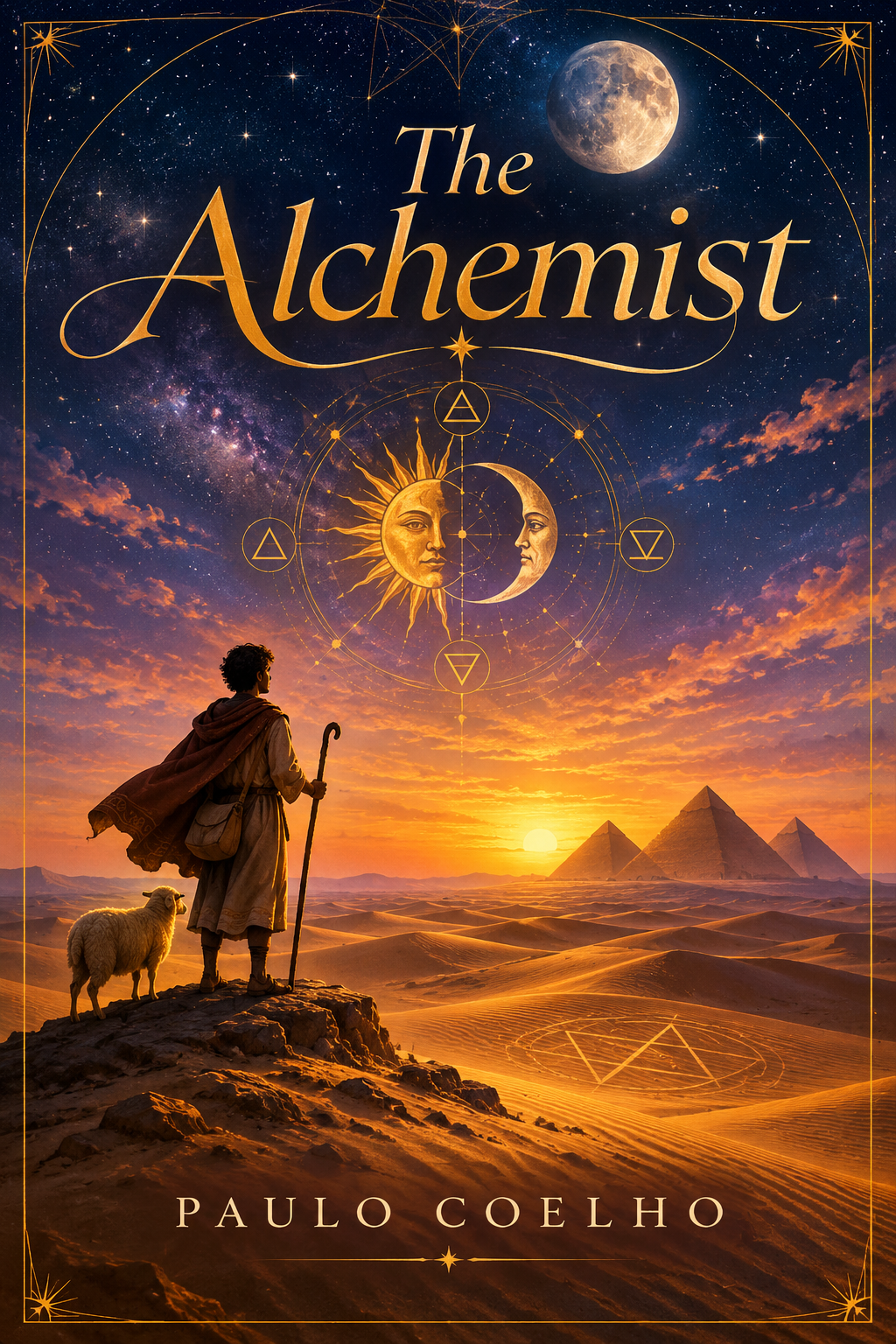
The Alchemist, written by Brazilian author Paulo Coelho, is an inspiring novel that explores the themes of dreams, destiny, courage, and self-discovery. First published in 1988, the story follows Santiago, a young shepherd from Spain who dreams of discovering a hidden treasure near the Egyptian pyramids. Determined to fulfill his dream, he leaves behind his familiar life and begins an extraordinary journey filled with challenges, valuable lessons, and unexpected encounters.
Chapter 1: The Shepherd and His Recurring Dream
The story begins in Andalusia, Spain, where Santiago works as a shepherd. He enjoys traveling through the countryside with his sheep and values the freedom of his lifestyle. Although his parents wanted him to become a priest, Santiago chose to explore the world instead.
One night, he sleeps inside an abandoned church beneath a sycamore tree. He dreams that a child takes him to the Egyptian pyramids and reveals the location of a hidden treasure. However, he wakes before discovering exactly where the treasure lies.
Because the dream occurs twice, Santiago becomes curious about its meaning. He visits a fortune-teller, who advises him to travel to Egypt and search for the treasure. In exchange, she asks for one-tenth of whatever he discovers.
Santiago initially doubts her advice, believing that traveling such a great distance because of a dream would be foolish.
Key lesson: Dreams can inspire us to discover opportunities beyond our ordinary lives.
Chapter 2: Meeting the King of Salem
While sitting in a town square, Santiago meets an elderly man named Melchizedek, who introduces himself as the King of Salem.
The old man explains the concept of a Personal Legend, which is the purpose or dream that a person is meant to fulfill. He tells Santiago that people often abandon their dreams because they become afraid of failure, responsibility, or uncertainty.
Melchizedek encourages Santiago to pursue the treasure at the pyramids. He also explains that the universe provides signs, called omens, to guide people toward their destinies.
Before leaving, the king gives Santiago two stones, Urim and Thummim, which can help him make decisions when he cannot interpret the signs around him.
Inspired by the conversation, Santiago sells his flock of sheep and prepares to leave Spain.
Key lesson: Achieving one’s purpose requires courage, sacrifice, and the willingness to leave familiar surroundings.
Chapter 3: Arrival in Africa and the First Major Setback
Santiago travels across the sea to Tangier, a city in North Africa. He quickly realizes that the language, customs, and surroundings are completely different from those of Spain.
While exploring the city, he meets a young man who appears friendly and offers to help him travel to Egypt. Santiago trusts him and hands over his money.
Unfortunately, the stranger disappears, leaving Santiago penniless in an unfamiliar place.
Overwhelmed by disappointment, Santiago considers abandoning his journey and returning home. He begins questioning whether following his dream was a mistake.
However, remembering Melchizedek’s teachings, Santiago decides to see his situation as a challenge rather than a permanent defeat.
He realizes that he must take responsibility for his future instead of depending entirely on others.
Key lesson: Setbacks are inevitable, but persistence determines whether they become failures or opportunities for growth.
Chapter 4: Working for the Crystal Merchant
Without money, Santiago approaches a crystal shop and offers to clean its dusty display glasses in exchange for food.
The shop owner, known as the crystal merchant, recognizes Santiago’s willingness to work and offers him employment.
Santiago soon discovers that the business has been struggling. He suggests displaying crystal outside the shop to attract customers and later proposes serving tea in crystal glasses.
These creative ideas increase sales and bring prosperity to the merchant.
During their conversations, Santiago learns that the merchant has always dreamed of traveling to Mecca. However, the merchant refuses to fulfill his dream because he fears that accomplishing it might leave him without anything to look forward to.
Santiago realizes that people respond to dreams differently. Some actively pursue them, while others prefer imagining success without taking risks.
After working for almost a year, Santiago earns enough money to return to Spain and purchase sheep. Instead, he decides to continue toward Egypt.
Key lesson: Hard work and creativity can transform difficult circumstances, but true fulfillment also requires taking action on one’s ambitions.
Chapter 5: Joining the Caravan Across the Desert
Santiago joins a caravan traveling toward Egypt across the Sahara Desert.
During the journey, he meets an Englishman who is studying alchemy. The Englishman hopes to meet a legendary alchemist capable of understanding the Philosopher’s Stone and the Elixir of Life.
He explains that alchemists seek to transform ordinary metals into gold through a process of purification.
The Englishman spends much of his time reading books, whereas Santiago prefers observing the desert and learning from his surroundings.
As they travel, Santiago begins understanding that the natural world possesses patterns and connections that cannot always be explained through books.
He also learns about the Soul of the World, the spiritual connection that unites all living things.
Meanwhile, reports of conflict between desert tribes make the journey increasingly dangerous.
Key lesson: Wisdom comes from both formal knowledge and personal experience. Understanding the world requires observation as well as study.
Chapter 6: The Oasis and Santiago’s Love for Fatima
The caravan eventually arrives at the oasis of Al-Fayoum, where travelers seek shelter from the ongoing tribal conflicts.
While helping the Englishman search for the alchemist, Santiago meets Fatima, a young woman collecting water from a well.
He immediately feels a powerful connection with her and falls deeply in love.
As their relationship develops, Santiago begins considering whether he should abandon his search for treasure and remain at the oasis.
Fatima, however, understands the importance of his Personal Legend. She encourages him to continue his journey, explaining that genuine love does not prevent someone from pursuing their destiny.
Santiago gradually understands that love should provide encouragement rather than become an obstacle.
He also recognizes that his relationship with Fatima is part of his personal journey, even if they must temporarily separate.
Key lesson: True love supports personal growth and allows individuals to pursue meaningful ambitions.
Chapter 7: The Vision of War
While observing two hawks flying above the desert, Santiago suddenly experiences a vision of an army attacking the oasis.
He believes the vision is an omen and decides to warn the tribal leaders.
The leaders initially question his warning because the oasis is traditionally considered neutral territory during tribal conflicts.
Nevertheless, they agree to prepare their defenses. They also warn Santiago that he will be punished if his prediction proves false.
The following day, armed attackers enter the oasis. Because the inhabitants are prepared, they successfully defend themselves.
Santiago’s vision saves many lives and earns him the respect of the tribal leaders.
His experience reinforces Melchizedek’s earlier teachings about interpreting signs from the universe.
It also attracts the attention of the mysterious alchemist, who recognizes Santiago’s unusual understanding of the world.
Key lesson: Intuition, awareness, and the courage to act can help people recognize danger and make important decisions.
Chapter 8: Santiago Meets the Alchemist
Santiago finally encounters the alchemist, a wise and mysterious man who lives in the desert.
The alchemist understands Santiago’s desire to discover the treasure and offers to guide him toward the pyramids.
However, he first challenges Santiago to consider whether his love for Fatima might prevent him from continuing.
Santiago admits that he would prefer to stay with her, but the alchemist explains that abandoning his Personal Legend could eventually lead to dissatisfaction and regret.
The alchemist teaches Santiago to listen to his heart, even when it expresses fear.
He explains that suffering often begins with the fear of losing something valuable, rather than with the actual loss itself.
With renewed determination, Santiago says goodbye to Fatima and leaves the oasis with the alchemist.
Key lesson: Fear of failure or loss should not prevent people from pursuing their true purpose.
Chapter 9: Learning the Language of the World
As Santiago and the alchemist travel deeper into the desert, Santiago receives lessons about nature, spirituality, and human existence.
The alchemist explains that everything in the universe is connected through the Soul of the World.
He encourages Santiago to pay attention to his heart, which can guide him toward his destiny.
Santiago also learns that the process of achieving a Personal Legend transforms an individual.
Just as alchemists attempt to purify metals into gold, human beings develop wisdom and strength through challenges.
The alchemist emphasizes that fear is often more damaging than the obstacles themselves.
Santiago gradually learns to trust his instincts and accept uncertainty.
He understands that reaching the treasure is important, but becoming the person capable of finding it is equally meaningful.
Key lesson: The journey toward a dream changes us by developing patience, confidence, wisdom, and self-awareness.
Chapter 10: Santiago’s Greatest Test
While crossing dangerous tribal territory, Santiago and the alchemist are captured by armed warriors.
To protect themselves, the alchemist tells the tribal commander that Santiago possesses the power to transform himself into the wind.
The commander agrees to release them if Santiago can demonstrate this extraordinary ability within three days.
Santiago becomes terrified because he has no idea how to perform such a miracle.
On the third day, he begins communicating with the desert, asking it to help him become the wind.
He then speaks to the wind and the sun, seeking their cooperation.
Finally, Santiago turns to the divine power that created all things, realizing that he is part of the same spiritual unity.
A tremendous windstorm sweeps across the desert, astonishing the warriors.
Believing that Santiago possesses extraordinary spiritual power, they release both travelers.
Key lesson: Faith, self-belief, and overcoming fear allow people to discover strengths they never knew they possessed.
Chapter 11: Reaching the Egyptian Pyramids
After escaping the tribesmen, Santiago and the alchemist reach a Coptic monastery.
There, the alchemist demonstrates his mastery by transforming lead into gold. He divides the gold into portions and gives Santiago one share before they separate.
Santiago continues traveling alone until he finally reaches the Egyptian pyramids.
Overcome with happiness, he realizes that he has accomplished the journey he once thought impossible.
Remembering his dream, he begins digging in the sand, hoping to uncover the hidden treasure.
However, a group of thieves arrives and attacks him.
When Santiago explains that he traveled to Egypt because of a recurring dream, one thief mocks him.
The thief reveals that he once dreamed of treasure buried beneath a sycamore tree inside an abandoned church in Spain. However, he considered the dream too foolish to follow.
Santiago immediately recognizes the location.
It is the same church where he slept with his sheep before beginning his journey.
Key lesson: Sometimes the answers we seek are close to home, but we must travel, learn, and grow before we can recognize them.
Chapter 12: The Treasure and the Meaning of the Journey
Santiago returns to Spain and visits the abandoned church where his adventure originally began.
He digs beneath the sycamore tree and discovers a chest containing gold coins, jewels, and precious stones.
He finally understands that his recurring dream was true, although the location of the treasure was different from what he initially believed.
Santiago also recognizes that the journey was essential to his success.
Without traveling to Africa, working for the crystal merchant, crossing the desert, meeting Fatima, and learning from the alchemist, he would never have discovered the treasure’s location.
More importantly, he would not have gained the knowledge, courage, and understanding that now define him.
He remembers his promise to give the fortune-teller one-tenth of the treasure.
The novel ends with Santiago thinking lovingly of Fatima and anticipating his return to her.
His journey has brought both material wealth and spiritual fulfillment.
Key lesson: The greatest treasure is not simply wealth but the wisdom, love, and personal transformation gained while pursuing a meaningful dream.
About the Author
Paulo Coelho
Paulo Coelho is a renowned Brazilian author, born on August 24, 1947, in Rio de Janeiro, Brazil. He is best known for his internationally bestselling novel The Alchemist, which explores dreams, destiny, and self-discovery. Before becoming a writer, Coelho worked as a songwriter and journalist.
Know More